Fuel Transport Safety & DOT Requirements for Delivery Drivers
Known errors in this article have been corrected.
A full claim-by-claim review is still pending. Confirm any figure with your state program before acting on it. Last verified 2026-09-08. Not legal advice.
Why Fuel Transport Compliance Starts at Your Driveway
Every fuel delivery that pulls into your station is carrying a federally regulated hazardous material — and the regulatory web surrounding that delivery is more complex than most gas station operators realize. While the driver and carrier bear primary responsibility for DOT compliance, station operators who understand these requirements can avoid refused deliveries, recognize unsafe conditions, and build stronger relationships with their fuel suppliers.
Federal fuel transport safety is governed primarily by the Department of Transportation’s Pipeline and Hazardous Materials Safety Administration (PHMSA) under 49 CFR Parts 171–180, along with the Federal Motor Carrier Safety Administration (FMCSA) rules in 49 CFR Parts 390–399. Non-compliance can result in civil penalties up to $102,348 per violation for HazMat infractions — rising to $238,809 where the violation results in death, serious illness, severe injury, or substantial destruction of property — with each day of a continuing violation counting as a separate offense (49 CFR 107.329), and carriers with poor safety ratings can lose operating authority entirely.
HazMat Classification: What’s Actually in That Tanker
Gasoline, diesel, ethanol blends, and aviation fuel are all classified as Class 3 Flammable Liquids under 49 CFR Part 173. This classification triggers a cascade of requirements covering placarding, packaging (tank design), driver training, documentation, and emergency response planning.
UN Numbers and Proper Shipping Names
Each product transported must be identified by its UN number and Proper Shipping Name on shipping papers and placards. The most common at fuel retail sites include:
| Product | UN Number | Proper Shipping Name | Packing Group |
|---|---|---|---|
| Gasoline | UN1203 | Gasoline | II |
| Diesel / ULSD | UN1202 | Diesel Fuel | III |
| Ethanol (>24% by volume) | UN1170 | Ethanol or Ethanol Solution | II |
Shipping papers (bills of lading) must accompany every load and be accessible to the driver at all times. When the driver is at the vehicle’s controls the shipping paper must be within his immediate reach while restrained by the lap belt and either readily visible to a person entering the driver’s compartment or in a holder mounted to the inside of the driver’s door; when the driver is not at the controls it must be in that door holder or on the driver’s seat (49 CFR 177.817(e)).
Tanker Vehicle Requirements Under 49 CFR Part 178 and 180
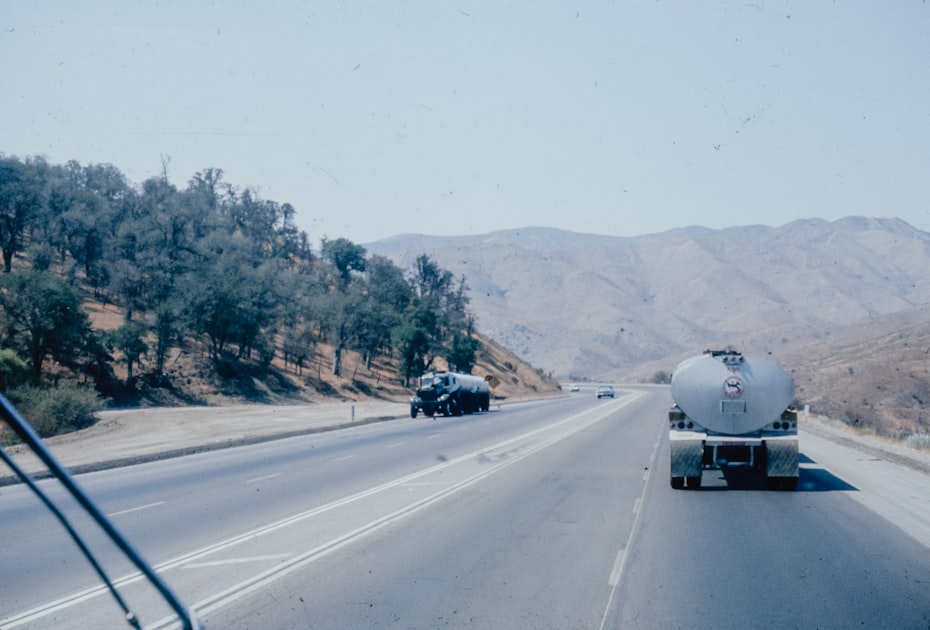
Cargo tank motor vehicles (CTMVs) used to transport fuel must meet strict design, construction, and inspection standards. Most fuel tankers are MC 306 or DOT 406 specification tanks — the standard aluminum elliptical tanks you see on the road daily.
Required Inspections and Testing
Under 49 CFR Part 180, Subpart E, cargo tanks must undergo:
- Annual external visual inspection by a registered inspector (every 12 months)
- Leakage test — every 12 months
- Pressure test (hydrostatic or pneumatic) — every 5 years
- Internal visual inspection — every 5 years, or every 12 months for insulated tanks and tanks carrying lading corrosive to the tank
- Lining inspection — every 12 months for lined tanks transporting lading corrosive to the tank
- Thickness testing — every 2 years for unlined tanks transporting material corrosive to the tank
The cargo tank must be durably and legibly marked with the date (month and year) and the type of each test or inspection passed — V for external visual, I for internal visual, P for pressure test, L for lining inspection, T for thickness test, K for leakage test — in letters and numbers at least 32 mm (1.25 inches) high near the specification plate or on the front head (49 CFR 180.415). As a receiving station operator, you are within your rights to ask a driver to show this certification if you have any concerns about tank condition.
Emergency Discharge Control Equipment
All MC 306/DOT 406 tanks must be equipped with emergency self-closing stop valves, vapor recovery systems (where state-mandated), and rollover protection for all outlets. Under 49 CFR 177.834(j), a person may not drive a cargo tank motor vehicle containing hazardous material unless all manhole closures are closed and secured and all valves and other closures in the liquid discharge system are closed and free of leaks — a rule routinely checked at roadside inspections.
Driver Qualification and HazMat Training Requirements
Fuel delivery drivers operate at the intersection of several federal licensing and training requirements. Station operators who understand these standards can better evaluate whether a new carrier or substitute driver is properly qualified.
Commercial Driver’s License (CDL) with Endorsements
Any driver operating a tanker vehicle with a gross vehicle weight rating of 26,001 lbs or more — or a combination vehicle with a gross combination weight rating of 26,001 lbs or more that tows a unit rated over 10,000 lbs — must hold a valid CDL (49 CFR 383.5). Fuel tanker drivers specifically need:
- Tank vehicle (N) endorsement — required for vehicles designed to transport liquid or gaseous material in tanks having an individual rated capacity of more than 119 gallons and an aggregate rated capacity of 1,000 gallons or more (49 CFR 383.5, 383.93)
- HazMat (H) endorsement — required for transporting any quantity of placardable HazMat
- Combination Tank + HazMat (X) endorsement — the standard combined endorsement for fuel tanker drivers
The HazMat endorsement requires a successful TSA security threat assessment (fingerprint-based background check), renewal every 5 years, and a knowledge test at CDL renewal. Drivers with disqualifying criminal convictions or immigration status issues cannot hold an H or X endorsement.
HazMat Training Under 49 CFR 172 Subpart H
Every HazMat employee — including drivers, loaders, and dispatchers — must be trained within 90 days of employment or a change in job function, and may perform hazmat job functions in the interim only under the direct supervision of a properly trained and knowledgeable hazmat employee (49 CFR 172.704(c)(1)), with recurrent training at least once every three years (49 CFR 172.704(c)(2)). Training must cover:
- General HazMat awareness and function-specific training
- Safety training (personal protection, emergency response procedures)
- Security awareness and, for employees with access to sensitive information, in-depth security training
- Tank vehicle-specific training under 49 CFR 177.816
The hazmat employer must create and retain a record of current training for each hazmat employee — inclusive of the preceding three years — for as long as that person is employed as a hazmat employee and for 90 days thereafter (49 CFR 172.704(d)).
Hours of Service Compliance
Fuel delivery drivers are subject to FMCSA Hours of Service (HOS) rules under 49 CFR Part 395. The key limits are:
- 11-hour driving limit after 10 consecutive hours off duty
- 14-hour on-duty window (no driving after 14 consecutive hours on duty)
- 30-minute break required after 8 cumulative hours of driving
- 60/70-hour limit in 7/8 consecutive days
Electronic Logging Devices (ELDs) are now mandatory for nearly all carriers under 49 CFR Part 395 Subpart B. Paper logs are only permitted for specific exemptions, such as drivers who operate within 150 air-miles of their reporting location and return within 14 hours — an exemption that applies to many local fuel delivery routes.
Placarding Requirements: What You Should See on Every Delivery Truck
Under 49 CFR Part 172 Subpart F, any vehicle transporting 1,001 lbs or more of a Class 3 flammable liquid in non-bulk packaging, or any quantity in bulk (cargo tanks), must display proper placards. For standard fuel tankers, you should always see:
- FLAMMABLE placards (red background, with white symbol, text, class number and inner border) on all four sides of the vehicle — the word “GASOLINE” may be shown in place of “FLAMMABLE” on a cargo tank transporting gasoline by highway (49 CFR 172.542)
- Placard must display the UN identification number (UN1203 for gasoline, UN1202 for diesel) either on the placard itself or on an orange panel adjacent to it
- Placards must measure at least 250 mm (9.84 inches) on each side, be diamond-shaped (square-on-point), and carry a solid line inner border approximately 12.5 mm inside the edge (49 CFR 172.519)
If a delivery truck arrives at your site without proper placards, you should not accept the delivery and should document the violation.
The Delivery Unloading Process: DOT Rules That Apply Onsite
The regulatory requirements don’t stop when the truck pulls in. During the actual unloading operation, both the carrier and your site have compliance obligations.
Attendance Requirements
Under 49 CFR 177.834(i), a cargo tank must be attended by a qualified person at all times during unloading. “Attended” means within 7.62 meters (25 feet) of the vehicle, with an unobstructed view of the tank and delivery area, and able to move the vehicle if necessary. The driver cannot go inside your store, sit in the cab with headphones on, or leave the site during unloading — a surprisingly common violation.
Bonding and Grounding
Bonding and grounding of cargo tanks is governed by 49 CFR 177.837(c): when a cargo tank is unloaded by a suction-piping system through an open filling hole, electrical continuity must be maintained from the cargo tank to the receiving tank. Bonding or grounding is not required when the transfer is made through a vapor-tight top or bottom connection, or when the tank is unloaded through a non-vapor-tight connection into a stationary tank with the metallic filling connection kept in contact with the filling hole. NFPA 30A (Code for Motor Fuel Dispensing Facilities and Repair Garages) also addresses static control during transfer. Your fill port covers and drop tube fittings should be equipped with bonding cable attachment points. If your site’s drop configuration requires bonding and the driver skips it, stop the delivery immediately.
Spill Prevention During Delivery
Your site’s SPCC Plan (Spill Prevention, Control, and Countermeasure Plan under 40 CFR Part 112) should include specific procedures for fuel delivery, including the positioning of spill containment equipment, spill kit locations, and who is responsible for monitoring the drop. Understanding when your SPCC plan needs updating is critical when you change tank configurations or add new product grades.
Carrier Vetting: Your Due Diligence as a Station Operator
Whether you’re working with a branded supplier’s dedicated fleet or sourcing product through a jobber who uses third-party carriers, you have a business and legal interest in verifying carrier safety credentials. Use these tools:
FMCSA Safety Data Resources
- FMCSA SAFER System (safer.fmcsa.dot.gov) — Free lookup for carrier registration, operating authority, insurance, and safety rating. Any carrier with a “Conditional” or “Unsatisfactory” safety rating is a red flag.
- SMS (Safety Measurement System) — Shows a carrier’s percentile scores across seven BASIC categories including HazMat compliance and driver fitness. Carriers in Alert status for HazMat have documented violation patterns.
- Insurance verification — Carriers hauling oil listed in 49 CFR 172.101, which includes gasoline and diesel, must maintain minimum financial responsibility of $1,000,000 (49 CFR 387.9). The $5,000,000 level applies to other hazardous materials such as Division 1.1–1.3 explosives, poison gas, and highway route-controlled quantities of radioactive material. Request a current certificate of insurance from any carrier you haven’t worked with before.
Red Flags to Watch for at Your Site
Train your site staff — especially managers working early morning drops — to recognize these warning signs:
- Missing or incorrect placards
- Driver unable to produce shipping papers on request
- Visible tank damage, leaking hatch seals, or compromised vapor recovery equipment
- Driver who leaves the delivery area unattended
- No bonding cable used before opening fill ports
- Driver appears fatigued, impaired, or unfamiliar with your site’s delivery procedure
Document any refusals in writing, photograph the vehicle and placard condition if safe to do so, and notify your fuel supplier immediately. Properly documenting your fuel delivery receiving process creates a record that protects you if a spill, incident, or regulatory inquiry follows.
State-Level Requirements Beyond Federal DOT Rules
Several states layer additional requirements on top of federal DOT minimums. Key examples include:
- California — CalOES and CUPA oversight adds state-specific HazMat business plan requirements and CARB vapor recovery certification for delivery equipment
- New York — Requires petroleum transport licenses through the NYS Department of Environmental Conservation in addition to federal authority
- Texas — TCEQ regulates petroleum transport and requires state environmental permits for certain carriers
- Florida — FDEP maintains its own petroleum carrier registration system
Contact your state environmental or transportation agency to confirm which state-specific endorsements or permits your carriers must hold. Your fuel management system records should capture carrier information for every delivery, making it easy to verify compliance across your supplier roster.
Penalties for Non-Compliance
The consequences of DOT violations in fuel transport are significant. Here’s a summary of current penalty ranges:
| Violation Category | Federal Penalty Range | Authority |
|---|---|---|
| HazMat violations (general) | Up to $102,348 per violation; minimum $617 for violations relating to training; each day of a continuing violation is a separate offense | 49 CFR 107.329 / PHMSA |
| HazMat violations causing death, serious illness, severe injury, or substantial destruction of property | Up to $238,809 per violation | 49 CFR 107.329 / PHMSA |
| HOS violations | Civil penalty amounts are set by FMCSA and adjusted annually for inflation; the current schedule is published in Appendix B to 49 CFR Part 386 | 49 CFR 395 / FMCSA |
| Operating without proper authority | Civil penalty amounts are set by FMCSA and adjusted annually for inflation; the current schedule is published in Appendix B to 49 CFR Part 386 | 49 CFR 386, Appendix B / FMCSA |
| Cargo tank inspection violations | Up to $102,348 per violation | 49 CFR 107.329 / PHMSA |
Action Items for Gas Station Operators
- Audit your current carrier roster — Run every regular fuel carrier through FMCSA SAFER and SMS. Flag any with Conditional safety ratings or HazMat BASIC alerts for review with your supplier.
- Request current insurance certificates — Verify your primary carrier and any backup carriers meet at least the $1,000,000 minimum required for carriers of oil and petroleum products under 49 CFR 387.9. Keep certificates on file and calendar renewal dates.
- Train your site managers on delivery red flags — Create a one-page checklist for morning managers covering what to look for and what to do if they need to refuse a delivery.
- Check your bonding equipment — Inspect fill port bonding attachment points quarterly. Replace any corroded or missing bonding lugs before your next delivery cycle.
- Update your SPCC delivery procedures — Confirm your plan includes current delivery protocols, emergency contacts, and spill kit locations matched to your actual tank layout.
- Verify state-specific carrier requirements — Contact your state DOT or environmental agency to confirm any permits or endorsements required beyond federal minimums.
- Document every delivery — Record the carrier name, DOT number, driver name, and tank certification visible date for each load received. This documentation is invaluable in the event of a spill investigation or regulatory inquiry.
Bottom line: You don’t control your carrier’s compliance program — but you control whether an unsafe delivery happens at your site. Knowing the rules gives you the standing to refuse, document, and protect your operation when something doesn’t look right.
Sources
Figures and citations in this article were checked against the following primary sources on 2026-09-08.
- 49 CFR 107.329 — Maximum penalties
- 49 CFR 172.101 — Hazardous Materials Table
- 49 CFR 172.519 — General specifications for placards
- 49 CFR 172.542 — FLAMMABLE placard
- 49 CFR 172.704 — Training requirements
- 49 CFR 177.817 — Shipping papers
- 49 CFR 177.834 — General requirements (loading and unloading)
- 49 CFR 177.837 — Class 3 (flammable liquid) materials
- 49 CFR 177.840 — Class 2 (gases) materials
- 49 CFR 180.407 — Requirements for test and inspection of specification cargo tanks
- 49 CFR 180.415 — Test and inspection markings
- 49 CFR 383.5 — Definitions
- 49 CFR 383.93 — Endorsements
- 49 CFR 387.9 — Financial responsibility, minimum levels
- 49 CFR 395.3 — Maximum driving time for property-carrying vehicles
- 49 CFR 1572.13 — Procedures for security threat assessment
- 29 CFR 1910.119 — Process safety management of highly hazardous chemicals
- Phase 3 reviewer brief